
When Future-Readiness Fails
Education for Resilience: Rootedness, Not Readiness

When an Oxford student writes that studying literature feels absurd “when the planet already feels like it's in ruins,” she captures something common among her generation. Schools have responded to uncertainty by mirroring it: constant change, skills training, future-readiness rhetoric. Students don't need more adaptation. They need roots.
The Meaninglessness Surge
Two weeks ago, Natalie Conboy, an undergraduate student at the University of Oxford, published a reflection in Cherwell, the student newspaper, that captures something many young people feel but struggle to articulate:
When the planet already feels like it’s in ruins, emerging with a Masters in some niche corner of French literary history does seem like a somewhat absurd endeavour. The guilt of not contributing towards a better future with each passing moment can lead to inertia: not feeling able or willing to do small things because I can’t single-handedly save the world.
Conboy’s paralysis has a popular name: ‘Doomerism’. This nihilism or hopelessness is a growing sentiment among youth today. In the Monitoring the Future study, the percent of American high school seniors who agree that ‘life often feels meaningless’ held steady around 15% for decades, until approximately 2012. Then it surged, nearly doubling to ~27% by 2023.
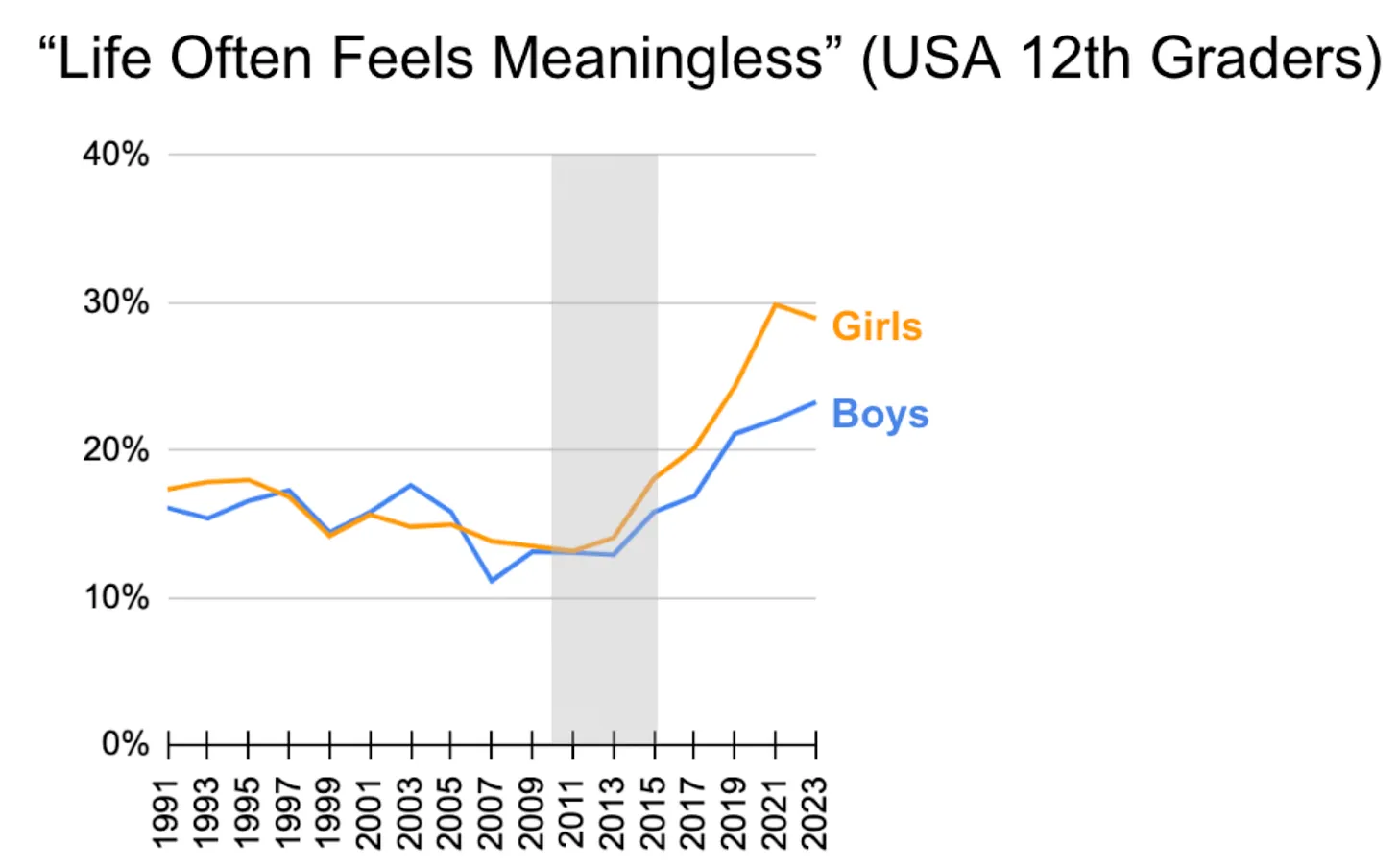
This surge in meaninglessness tracks closely with the well-documented collapse in youth mental health.
But Conboy’s worries aren’t held without reason. She and her generational peers consistently report concerns, grounded in evidence, about the climate, economic uncertainty, and political instability. 37% of Canadian teens, for example, report that climate change impacts their mental health, and “nearly half of Gen Zs (48%) and millennials (46%) say they do not feel financially secure,” according to an international survey from Deloitte.
Schools have responded to this uncertainty with unprecedented focus on preparation. Future-readiness. Skills training. Constant vigilance around a changing job market. We’ve never worked harder to equip students for what’s coming.
So why do they feel more hopeless than ever? Why does preparation create fragility?
The answer lies in what we’re preparing them for, and what we’re failing to provide now.
Building on Quicksand
Edward Osborne Wilson, the American biologist, famously observed that humanity suffers from “paleolithic emotions, medieval institutions, and godlike technology”. This discord, between what we are, how we organize ourselves, and what we’ve invented, lies at the heart of many contemporary problems.
Education faces a similar dilemma with equally consequential stakes. The developmental needs of children operate at the pace of biology. Human formation hasn’t changed: adolescents still need stable relationships, opportunities for sustained attention, and time to develop a coherent identity. But the economy moves at the pace of technological innovation. And when schools look to that economy for guidance — when they adopt what I call the Marketplace Mirror model — they shackle biological development to technological disruption.
The result is predictable: students feel perpetually off-balance, as outlined above. Each wave of innovation demands new skills, new competencies, new ways of being. Yesterday’s essential skillset becomes today’s obsolete knowledge. The pathways that seemed secure dissolve. And under these conditions, young people are trained not to develop deep expertise or stable identities, but to be perpetually reactive, always adapting and never rooted.
The Marketplace Mirror model rests on a well-intentioned but calamitous assumption: that preparing students for a changing future means immersing them in constant change now. But a mirror facing the marketplace isn’t guaranteed to reflect something stable to orient toward. It can, instead, reflect a maelstrom.
What students actually need is not to be trained (exclusively) for constant adaptation, but the cultivation of what persists in spite of external conditions. They need stability precisely because the external world can, at times, offer very little. They need what philosopher Simone Weil, writing during the Second World War’s profound uncertainty, called “the most important and least recognized need of the human soul”: rootedness.
What Uncertain Times Actually Demand from Schools
When the future feels foreclosed, as Conboy suggested in her reflection, young people need stable ground in the present. They need to know they belong somewhere, to someone, as part of something that existed before them and will persist after them. They need the sense that they are not isolated atoms battered by forces beyond their control, but participants in communities and traditions that provide both shelter and purpose.
Yet at the precise moment when students most need this sense of rootedness, they report feeling more alienated from their schools than ever before:
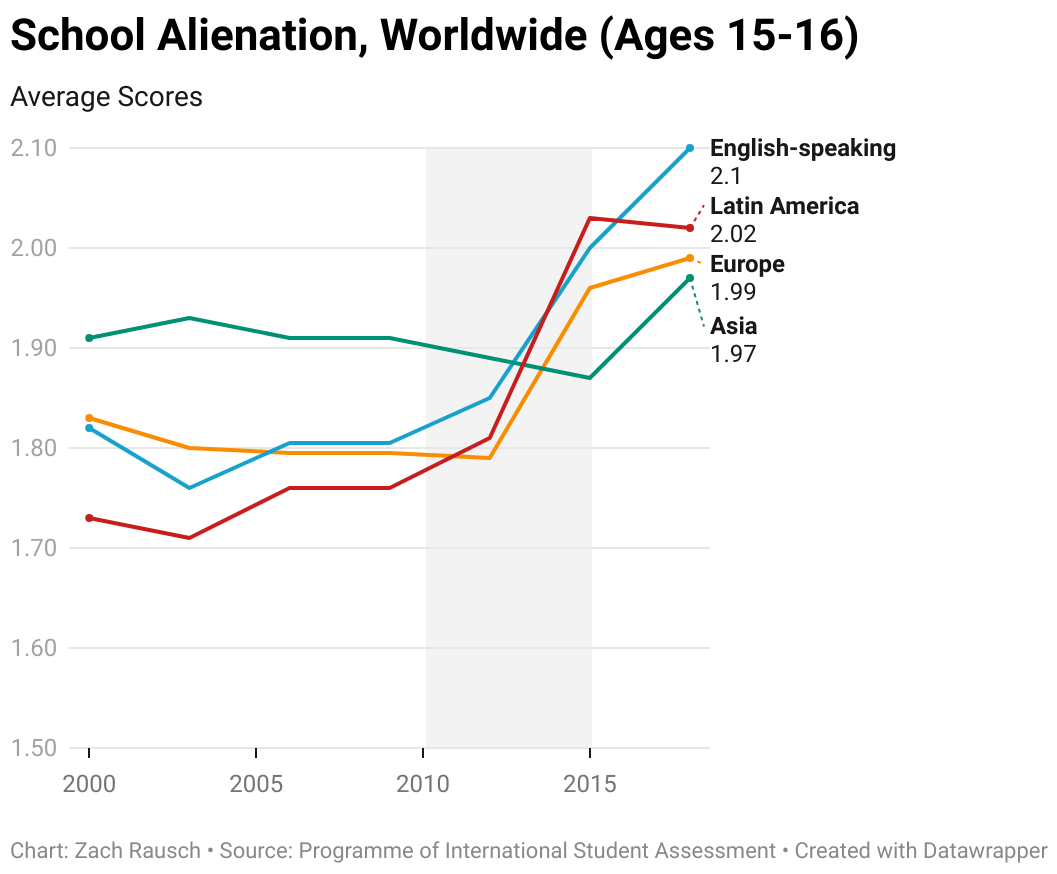
This is not a coincidence. When schools organize themselves around the Marketplace Mirror model, always chasing the next trend and treating education as skills acquisition rather than human formation, they can’t provide the stability young people need. A community that constantly remodels itself, redefines its mission, and reorients its vision is not a community at all; it’s just a collection of people reacting to external pressures.
Simone Weil understood this problem with intimate clarity. Writing during World War II as a Jewish intellectual exiled from Nazi-occupied France, she experienced a radical form of alienation. Everything that had been stable in her life was violently disrupted. From this position of profound displacement, she wrote what would become her best known work: The Need for Roots.

Weil developed her theory of rootedness not in stable times, but in the midst of catastrophic uncertainty. She wrote for a generation that had watched the entire European order collapse, that faced an opaque future, that had every reason to despair. Her answer to that hopelessness wasn’t ‘adaptability’ or ‘flexibility’. It wasn’t resilience as we currently understand it. Her answer was rootedness.
She defined it this way: “Real, active, and natural participation in the life of a community which preserves in living shape certain particular treasures of the past and certain particular expectations for the future.”
It’s worth unpacking this sentence because it provides us with a blueprint for what education should provide its students today:
“Real, active, and natural participation” - not passive membership through proximity, but genuine contribution to something beyond oneself. As I explored in my recent piece on school belonging, students must do something that matters to the school community they participate within.
“in the life of community” - not only individual achievement measured against others, but belonging to a collective group that has shared purposes and mutual obligations.
“which preserves in living shape” - not engaging with dead traditions, but creating and preserving communal practices, understanding that their worth is found in the belonging that emerges from shared experience.
“certain particular treasures of the past” - specific knowledge, wisdom, stories, and practices inherited from previous generations. A sense of intergenerational continuity is imperative to a sense of stability.
“and certain particular expectations for the future” - shared vision of what the community is working toward — a concrete commitment, resistant to external shocks, that shapes action in the present.
Rootedness — true belonging — isn’t static. It’s not a resistance to change. Rather, it’s the stable ground from which change, and meaning-ful-ness rather than meaning-less-ness, becomes possible. It’s what allows young people to face uncertainty together rather than as atomized individuals frantically trying to adapt to forces beyond their control. As collective participants, they belong to something larger that provides both shelter and purpose.
This is what Marketplace Mirror schools cannot offer. And this is what students, especially today, desperately need.
Resilience Comes from Rootedness, Not Anticipation
Resilience as it’s currently understood in education — grit to persist toward predetermined outcomes and the capacity to bounce back from setbacks — is not what today’s students need. A robust resilience is unwavering. It anchors the self in uncertain conditions. It is Weil’s rootedness: the cultivation of stable internal ground from which young people can meet an unpredictable future as self-aware agents rather than perpetually reactive consumers.
This kind of resilience is not built through acquiring instrumental skills whose value depends on guessing correctly about the future. It’s built by nurturing stable internal capacities that remain valuable regardless of external conditions. These capacities develop across three dimensions that schools must systematically cultivate:
Cognitive Rootedness: The Capacity to Direct One’s Own Attention
When students can sustain focus, think independently, and work through difficulty without external scaffolding, they possess cognitive capacities that persist across contexts. As I’ve written previously, these fundamental capacities — sustained attention, working memory, executive function — are more valuable than familiarity with any particular tool or platform.
Yet Marketplace Mirror schools routinely sacrifice cognitive development for technological efficiency. To foster cognitive rootedness, schools need to:
Preserve practices that build fundamental capacities. Handwriting strengthens retention. Organizing an agenda develops executive functioning. Reading physical texts in quiet spaces improves sustained attention.
Teach deep knowledge in stable domains. While our knowledge and interpretation of history, science, literature, mathematics, and music evolves over time, their importance remains stable. Rather than constantly updating a set of ephemeral skills that the marketplace may value more or less at any given moment, engaging deeply with subjects of perennial significance is a safer bet.
The result is confidence grounded in capability. Students who can direct their own attention and solve problems independently can face uncertainty with self-assurance rather than anxiety.
Narrative Rootedness: Developing a Coherent Sense of Self Across Time
Psychologist Dan McAdams defines narrative identity as “the internalized and evolving story of the self that a person constructs to make sense and meaning out of his or her life.” His research shows that people who construct coherent life narratives — stories of personal agency, growth through difficulty, and a connection to something larger — enjoy better mental health and greater resilience when facing challenges.
But a strong narrative identity requires stable ground to develop from. Young people need continuity, not constant change. They need to see how their past connects to their present and shapes their future. They need role models who demonstrate that stable identity across time is possible.
Marketplace Mirror schools undermine narrative development by privileging what’s new over what’s enduring, and peer influence over wisdom from elders. As Jonathan Haidt points out, digital technologies shift cultural transmission from vertical (elder to youth) to horizontal (peer to peer).
When curriculum changes every few years, when teachers and administrators rotate annually, and when content is whatever is trending, students can’t develop the temporal continuity necessary for strong narrative identity.
Narrative rootedness requires schools to:
Provide sustained relationships over time. Cohort continuity, multi-year teacher-student bonds, and mentoring relationships that span grades give students access to adults who witness and nurture their growth, helping them construct meaningful stories about who they’re becoming.
Teach enduring content. When students engage deeply with knowledge that has mattered to people over long tracts of time, they join a conversation that transcends the current moment. Enduring content exists across all cultures and traditions — whether that’s Homer or the Bhagavad Gita, Shakespeare of Toni Morrison, Euclid or Al-Khwarizmi. This is a call to recognize that narrative identity, regardless of intellectual inheritance, benefits from enduring significance.
The result is students less susceptible to external validation. They can articulate their values, commitments, and place in a much longer story.
Embodied Rootedness: Active Participation in Place and Community
Rootedness, as Weil tells us, must be “real, active, and natural participation.” Students must feel a connection to physical place and to local community. They need to understand where they stand geographically, historically, and culturally. And they need to experience the tangible consequences of their actions.
This is not about service projects or resume building for post-secondary applications. It’s about genuine integration into “the life of community” through sustained, meaningful participation.
Embodied rootedness requires schools to:
Ground learning in local place. Study the watershed that provides your drinking water. Learn the indigenous history of the land you live on. Understand your region’s culture, ecology, and economy. Place-based education helps students develop knowledge of where they are, a stronger sense of civic identity, and environmental responsibility.
Create real responsibility within the school community. In Japan (sōji) and in Korea (cheongso dangbeon), students participate in the daily cleaning of their schools. Students are collectively responsible for maintaining their learning environment. This practice creates a sense of institutional ownership through shared effort and accountability. Students belong because they actively sustain their community together.
When students participate actively in maintaining and improving their communities, they learn that their actions actually matter. This is the antidote to Conboy’s paralysis.
Hope is not an abstract feeling. It’s kindled by tangible experience of effective action. When young people see that their participation creates real, even incremental change, they develop resilience grounded in agency rather than adaptation.
Together, these three dimensions create the internal architecture students need to navigate uncertainty without succumbing to despair. This is resilience as rootedness: not the ability to constantly adapt to whatever the marketplace demands, but the self-assurance to remain grounded when the world shifts.
The Ground Beneath Their Feet
Natalie Conboy worried that studying French literature seemed absurd “when the planet already feels like it’s in ruins.” But the real absurdity is that she and so many of her generation feel like they don’t have the stable ground from which to make their choices feel meaningful.
Conboy’s sentiment isn’t her fault. Instead, it should be a signal that students don’t need more promises about the future or another pivot to the latest trend. What they need is to witness adults making principled decisions based on stable values rather than reactive fear.
When schools remove smartphones because attention is developmentally essential. When they teach enduring knowledge because vertical transmission matters. When they protect time for deep work despite the pressures for efficiency and convenience. These decisions model something that students like Conboy are missing: adults acting with conviction rather than capitulation.
Simone Weil wrote The Need for Roots while everything stable in her world collapsed. She understood that what any human being needs when faced with uncertainty isn’t training in adaptability, it’s what’s missing: they need roots.
This is what students facing an uncertain future deserve. Promises that can’t be guaranteed aren’t helpful, but a stable sense of self, community, and place is the most beneficial thing we can offer our students. By ensuring that they can think independently and participate meaningfully in something larger than themselves, we offer security and balance.
When students see their schools make decisions based on these commitments, they learn that meaning is possible even when the future is uncertain. They learn that there is ground beneath their feet from which they can begin to build.
The choice between mirroring the maelstrom and providing roots is one every school must make. If this framework helps you think about that choice, I hope you'll share it with colleagues, administrators, and parents in your community. The conversation matters as much as the conclusions.
Interested in reading more?


As a new but older teacher—I got certified as a second career in my 50s—I want to begin every school year of my secondary ELA classes with a classroom discussion about what school is for. So many students answer the question with some variation of “So I can get a good job.” I want them to interrogate that idea, to pick it apart and expose its essential falsehood and quackery, to see that it’s designed to reduce them to nothing more than a replaceable part in a profit machine. Thank you for reinforcing my instinct about this.